

It’s a warm Sydney evening, the back door is open to catch the breeze, and within minutes the mozzies have found their way inside. Most homeowners know that moment. The fix seems simple: get a screen door. But once you start looking, you’ll find three main types, and each one works very differently.
This guide compares hinged, sliding track and magnetic screen doors side by side, so you can work out which one suits your doorway, your budget and how much protection you actually need.
Why the Type of Screen Door Matters
A screen door does more than keep insects out. Depending on how it’s built, it can also let you leave the main door open without leaving the house exposed. That second job is where the three types differ most.
Break-ins are still a real concern. The ABS Crime Victimisation survey estimates that around 196,600 Australian households had a break-in during 2024–25, with roughly 217,500 more facing an attempted one. Closer to home, NSW Police recorded 18,136 home break-ins in 2025, according to the state’s crime statistics bureau.
Those numbers are a good reason to think about strength, not just airflow, when you choose. It’s the first question the team at OnGuard Security Products asks homeowners.
Hinged Screen Doors
A hinged screen door swings open on hinges, just like your front door. It’s the most common choice for front and back entries with a standard single door.
The big advantage is security. Because the frame is fixed to the doorway on one side and locks into it on the other, a hinged door can take a proper lock, often a triple lock that secures the door at three points. With a steel or aluminium frame and stainless steel mesh, a hinged security door can stand up to serious force.
The trade-off is that it needs room to swing outwards. On a narrow porch or a doorway next to a step, that can be awkward, so check there’s clear space before you commit.
Sliding Track Screen Doors
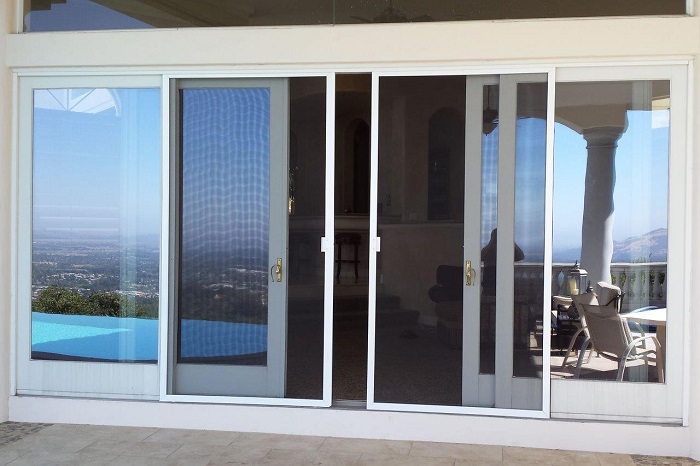
Sliding screen doors run along a track at the top and bottom of the frame. They’re the natural match for sliding glass doors that lead out to a deck, patio or backyard.
They take up no extra space when open, which makes them ideal for busy outdoor areas where people come and go. A well-made sliding security door uses a heavy frame, a strong track and anti-lift blocks so it can’t simply be lifted off its rollers.
The weak point on cheaper models is the track itself. Dirt, leaves and pet hair build up and make the door stick or jump the rails. A quick clean every few weeks keeps it gliding, and quality rollers make a big difference over time.
Magnetic Screen Doors
Magnetic screens are the lightweight option. They’re usually two mesh or fabric panels that hang across the doorway and snap together in the middle with magnets. You walk straight through, and they close behind you.
They’re cheap, quick to put up and handy for renters, pet owners or anyone who wants a hands-free door. Kids and dogs tend to love them.
However, they offer no security at all. A magnetic screen keeps flies out, but anyone can walk through it, and the mesh tears easily. Think of it as an insect barrier, not a door.
Which Type Is Right for Your Home?
Start with the doorway. A standard swinging door usually suits a hinged screen, and a sliding glass door suits a sliding screen. Magnetic screens fit almost anywhere but only solve the bug problem.
Next, think about what you want the screen to do. If you’d like to leave the main door open at night or while you’re out the back, choose a hinged or sliding security door. Look for products that meet Australian Standard AS 5039, which covers security screen doors and window grilles.
Finally, get a professional measure and quote. Doorways are rarely perfectly square, and a custom fit is what makes a security door work properly. A good installer will talk you through the options for your home.
If you live in Sydney’s west, it’s also worth looking at local options for security screens in Fairfield, where hinged and sliding security doors are made to measure for each home.
The Bottom Line
Hinged screen doors give the strongest protection for swinging doors, sliding screens suit patio doors and save space, and magnetic screens are a budget fix for insects only. If security matters to you, skip the magnets and choose a properly made hinged or sliding security door that lets the breeze in and keeps intruders out.
Frequently Asked Questions
Can a sliding security door be as strong as a hinged one?
Yes, if it’s built well. Look for a heavy frame, stainless steel mesh, quality rollers, anti-lift blocks and a solid lock. Both types can meet Australian Standard AS 5039 when they’re made and installed correctly.
Do magnetic screen doors keep out mosquitoes?
They keep out most flying insects when the magnets close fully. Small gaps can form at the bottom or along the seam, so they’re less reliable than a fixed mesh screen door.
Can I fit a screen door to an existing doorway?
In most cases, yes. Hinged and sliding screens are made to measure and fixed to the existing frame. An installer will check that the doorway is sound and square before fitting.
How do I keep a sliding screen door running smoothly?
Vacuum or brush the track every few weeks, wipe it clean and check the rollers. Avoid oil-based lubricants, which attract grime. A dry silicone spray works better.
What does AS 5039 mean on a security door?
AS 5039 is the Australian Standard for security screen doors and window grilles. Products that comply have passed tests for impact, knife cuts, levering and pulling, so they offer real protection rather than just looking the part.